Showing posts with label Stalinism. Show all posts
Showing posts with label Stalinism. Show all posts
Monday, 24 August 2009
Midnight of the century
Posted item #15 'The Moscow Trials'
The 1930s were turbulent times and witnessed the historic defeat of the working class in two hugely important ways: the rise of fascism and the entrenchment of Stalinism in the Soviet Union. The triumph of Hitler's Nazis in 1933 represented a crushing defeat for the powerful German working class, while the consolidation of Stalin's power crushed the hopes of 1917 and nearly extinguished the authentic marxist tradition.
Trotsky, more than anyone, carried the torch of genuine revolutionary socialism forwards. He did this in extraordinarily harsh and brutal conditions, for himself personally and for his supporters.
Many of Trotsky's 1930s writing exemplify the best in the marxist tradition - for example his analysis of the events in Germany - and he strove to continue revolutionary organisation, despite awful repression in the Soviet Union (from where he was exiled in 1929) and being so marginalised everywhere.
The Moscow Trials of 1935-37 symbolise how far Stalin's counter-revolution had gone, how utterly removed from the revolutionary aspirations of the post-1917 period his regime had become. Many of the Bolsheviks' Central Committee from 1917 were killed, following grotesque and absurd show trials in which the accused were forced to confess to crimes they had never committed. They were tarred with the terrible accusation of being in league with Trotsky, who was in turn supposedly a fascist agent (ludicrous on several levels, not least because he was Jewish).
One of the strengths of Cliff's account of the trials is his explanation of their material basis. They weren't simply the excesses of a crazed dictator, but had important political motives and served the Stalinist bureaucracy's need, as the head of a state capitalist society, for the eradication of any threats to its own economic and political power. Cliff also looks at the degradation of the revolution and the rising power of the bureacracy to account for how once-heroic revolutionaries could abase themselves so pitifully before Stalinist power.
Cliff's account of the Moscow trials, which I'm posting here, is a chapter from the fourth and final volume of his epic Trotsky biography. This volume covers the years from Trotsky's expulsion from the Communist party in 1927 until his assassination by a Stalinist agent in Mexico in 1940.
This volume can seem bleak - these years were truly the midnight of the century, his personal suffering was immense, Trotskyism became a tiny and marginal political force - but Cliff offers a wealth of historical insight and teases out the important theoretical insights found in Trotsky's immense corpus of writing from this time.

Friday, 14 August 2009
Trotskyism after Trotsky
Posted item #8 Interview: 50 years of the International Socialist tradition
Tony Cliff's vital theoretical breakthrough was in the late 1940s, when he developed a theory of the Soviet Union, and its sattelite states in Eastern Europe, as state capitalist. This required a break form the dominant analysis in the Trotskyist movement internationally, which was riven with confusion about how to understand Stalinism. He was forced out of the British Trotskyist organisation of the time, along with those who agreed with him, and had to found, in 1950, an initially tiny independent group which took its name from the publication it produced: Socialist Review.
Cliff, however, viewed his work - theoretically and practically - as continuing the authentic Marxist tradition represented by Marx, Engels, Luxemburg, Lenin, Trotsky and many lesser names. He had to start small with the Socialist Review Group, but this was preferable to staying with a moribund organisation that had lost its way. Considerable far-sightedness and determination was required to pursue this course of action.
The interview posted here was conducted in 1997, half a century after Cliff first speculated that the so-called Communist countries might in fact be a version of capitalism, but one where the state essentially took the role of employer, where in the absence of competition between private firms there was nevertheless fierce competition - economically and militarally - with rival states.
Tony Cliff's vital theoretical breakthrough was in the late 1940s, when he developed a theory of the Soviet Union, and its sattelite states in Eastern Europe, as state capitalist. This required a break form the dominant analysis in the Trotskyist movement internationally, which was riven with confusion about how to understand Stalinism. He was forced out of the British Trotskyist organisation of the time, along with those who agreed with him, and had to found, in 1950, an initially tiny independent group which took its name from the publication it produced: Socialist Review.
Cliff, however, viewed his work - theoretically and practically - as continuing the authentic Marxist tradition represented by Marx, Engels, Luxemburg, Lenin, Trotsky and many lesser names. He had to start small with the Socialist Review Group, but this was preferable to staying with a moribund organisation that had lost its way. Considerable far-sightedness and determination was required to pursue this course of action.
The interview posted here was conducted in 1997, half a century after Cliff first speculated that the so-called Communist countries might in fact be a version of capitalism, but one where the state essentially took the role of employer, where in the absence of competition between private firms there was nevertheless fierce competition - economically and militarally - with rival states.
Saturday, 8 August 2009
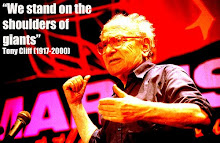
The revolutionary tradition: standing on the shoulders of giants

All four volumes of Tony Cliff's biography of Trotsky are now online, at the Marxists' Internet Archive, as well as two volumes of his Lenin biography. This is a major advance in getting Cliff's work online, so a big thank you to those involved. And thanks to the Histomatist blog for alerting me to the news, in the post 'Tony Cliff on Lenin and Trotsky'.
There's a useful chapter about the writing of these biographies in Cliff's memoir, 'A World to Win'. He comments that volume 1, 'Building the Party', is the cornerstone of the Lenin biography. It is basically the nearest you'll get to a definitive manual on building a revolutionary party. Not, it ought to be stressed, because any of us can mechanically apply what the Bolsheviks did in pre-1917 Russia in radically different conditions. Cliff recognised the differences required, but he was also exceptional at identifying the general lessons that could be derived from Lenin's experiences in taking the Bolsheviks from small underground circle to leadership of the only successful workers' revolution in history.
Cliff also suggested that it is the final volume, covering the dark years 1927 (expulsion from the Communist Party) to 1940 (assassination by a Stalinist agent), that was most important in his Trotsky biography. This was partly because it was unique in being the only volume of either biography to cover years Cliff had personal recollection of. He became a Marxist in British-ruled Palestine in around 1933 and was a dedicated Trotskyist - admittedly in a tiny group on the fringes of the Trotskyist movement to begin with - from the mid-1930s.
He also felt especially strongly about the book - titled, poetically, 'The Darker the Night, the Brighter the Star' - because he admired immensely the courage and resilience shown by Trotsky in these years, and felt pity and sorrow when contemplating what he endured. It is a powerful personal tribute - to someone who sustained himself and his political commitment through Nazism and Stalinism - as well as an acute political analysis. These were the years of - to cite just one important area - Trotsky's astute analysis of the rise of Hitler to power in Germany, which Cliff regarded as amongst the greatest of Trotsky's contributions to the Marxist tradition.
Lenin volume 1 was surely also very personally relevant - indeed I've heard it suggested that many passages could easily be interpreted as autobiography, as Cliff is to an extent writing about his efforts (in the early to mid 70s) to build revolutionary organisation through the International Socialists (which became the SWP on 1 January 1977). His own preocupation with turning IS into a disciplined, cohesive revolutionary party was the motor behind his devouring of Lenin's work - and, furthermore, writing a multi-volume biography - from 1968 onwards. His very short piece on democratic centralism in summer 1968 effectively marked the beginning of a massive study of the Bolsheviks, and also the start of a determined effort to re-orient what was then the International Socialists.
The Lenin biography was completed by the end of the 1970s and for generations of SWP members it served as a valuable guide to a hugely important era in revolutionary history and a source of insight into party building, the nature of revolution, and some knotty questions around Leninism and the common charge that the seeds of Stalinism could be found in the Bolshevik Party. The biography, published during the Cold War, was a superb refutation of precisely that charge.
The Trotsky biography came later, between 1988 and 1993. Cliff acknowledged in his memoir that he'd rather not have had the time to write either biography. It was the onset of the downturn in the mid-1970s that facilitated the Lenin biography - such a task would have been impossible in the heady days of revolt in the late 60s and early 70s. Likewise he could only devote such time to Trotsky because of the relatively low levels of resistance and struggle during the period in which wrote it, though he always took an active interest in contemporary politcs and day-to-day party building.
It was appropriate that the Berlin Wall fell and the Soviet Union collapse during this latter period: events that vindicated Cliff's pioneering analysis of forty years earlier, and which created an opening for the rediscovery of the tradition of which Trotsky was such a magnificent representative.
That tradition was a world away from the monstrosities of Stalinism. It was, and is, a tradition of socialism from below, with the self-activity of the working class at its core. Today, with capitalism in its deepest crisis since Trotsky's final struggle (and Cliff's formative years), the need for us to carry forward that thread of genuine socialism is profound. The biographies of Lenin and Trotsky are an aid to us in the project of strengthening revolutionary socialism in the 21st century.
A full index of Cliff's online writings - including the biographies - can be found here: www.marxists.org/archive/cliff/
Subscribe to:
Posts (Atom)