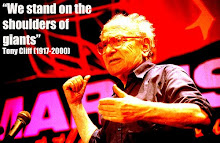
Posted item #13 'Roots of Israel's violence'
Tony Cliff wrote many articles, over a long period of time, on the subject of Palestine. This can partly be explained by personal biography - it's where he grew up, in a Jewish family during the 20s and 30s, and it was (by his own account) his disgust at the unequal treament of Arab and Jewish children that first radicalised him. His interest, though, was also sustained by recognition of historic Palestine's pivotal importance in the whole 20th century history of Western imperialism and the Middle East.
Implacable opposition to every manifestation of US imperialism was a cornerstone of Cliff's politcal outlook. In the aftermath of World War Two America unquestionably became the dominant global power - with, of course, the Soviet Union as geopolitical rival, though the US was always far more economically powerful - while Britain went into decline. The decay of the British Empire was symbolised by its humiliation in the Suez Crisis of 1956, since when the UK has consistently served as junior partner to the US.
Prior to World War Two, rival imperialisms - led by the British - carved up the Arab world for themselves. After the war it was America that took over the dominant role in this region, and ever since it has ruthlessly sought to preserve its military, polical and economic supremacy in an oil-rich and strategically vital area of the globe. The founding of Israel in 1948 -dependent on the brutal expulsion of the Palestinian people - suited American imperialist interests just fine.
For over 60 years, Israel has been a proxy aggressor for US imperialism in the Middle East, a watchdog in the Arab world. A small country reliant on vast US 'aid', it has been utterly reliable in prosecuting the wishes of the world's superpower. Cliff understood this and was an anti-Zionist in conditions much less favourable than today.
The article I'm posting here was first published in 1982, a year of renewed Israeli violence against the Palestinians, and dug into history to unearth the roots of Israel's oppression and barbarism towards those whose land it stole in the Nakba of 1948.
Showing posts with label imperialism. Show all posts
Showing posts with label imperialism. Show all posts
Wednesday, 19 August 2009

Western imperialism after WW2
 A major challenge for Cliff, arriving in Britain after World War Two, was explaining the relative lack of economic depravation. While there was still poverty, it clearly wasn't a re-run of the hungry 30s, an era of mass unemployment.
 This was a puzzle because Trotsky, who died in 1940, had predicted a crisis for capitalism after the war. Orthodox Trotskyists assumed Trotsky must have been right so - despite the evidence of their own eyes - they clung to the belief that the system was entering, or about to enter, a crisis.
Posted item #12 'The permanent arms economy'
Cliff realised that if theory and reality don't match it must be the theory that's wrong - so he set about developing an explanation for the emerging post-war boom. Together with Michael Kidron, a young comrade in the International Socialists, he evolved an account - in the second half of the 1950s and early 60s - of postwar Western capitalism.
This account explained the boom, but also pointed to the system's underlying instability - the prosperity couldn't last forever, and at some stage there would be a return to the cycle of boom and slump. When the global economy entered recession in around 1973 Cliff and Kidron were proved absolutely right.
Their account was labelled a 'theory of permanent arms economy', as it emphasised the role of mass investment in arms production - especially from the US, by now economically dominant - in sustaining the boom. Along with the theory of state capitalism (which explained the Soviet Union and Eastern Europe) and his account of 'deflected permanent revolution' (which made sense of changes in large parts of the 'Third World'), Cliff's analysis of Western post-war society provided an overall picture of the world system.
This theoretical troika enabled IS supporters to remain firm and consistent in a politically difficult climate. The left was dominated by supporters of offical Communism or those who subscribed to reformism - at a time of stability and prosperity for Western workers, there was little opening for a revolutionary anti-capitalist alternative. But the steadfastness and patient work of IS activists in the 50s and 60s laid the basis for larger-scale poltical interventions in the crisis-ridden 70s and beyond.
Monday, 27 July 2009
1935: Cliff's first published piece
Posted item #2 The Present Agrarian Crisis in Egypt
'Already in 1935 I had written an article entitled The Present Agrarian Crisis in Egypt, and sent it to a serious economic journal published in Tel Aviv, Hameshek Hashitufi. I was surprised by the editor’s letter accepting the article. He wrote that it was clear that I had spent years in studying the subject. As a matter of fact I spent about a fortnight. The article was a result of my enthusiasm for the subject, the study of a number of statistical reports and absorbing Lenin’s writings on the agrarian question in Russia. (In passing, one day I came across the editor, and both of us were very embarrassed when he saw me as a young man aged 18 wearing shorts.)'
(From Cliff, 'A World to Win', p33)
Cliff was born in Palestine, to a Jewish family, in May 1917. He changed his name from Ygael Gluckstein to Tony Cliff only after becoming active in British Trotskyism from the late 1940s onwards. Palestine was where he became politicised and where he was an active Marxist for over a decade. He returned to the topic of Palestine - and more broadly to the Middle East and the impact of imperialism on the region - many times later in life.
His rebellion against the Zionist orthodoxies of much of his family - and indeed of left-wing Jewish circles - was crucial to his political development as a teenager. He also devoured the Marxist classics - above all Marx himself, but also Engels, Lenin, Trotsky and Luxemburg - in these years.
He was clear, from an early age, that the internationalist spirit of Marxism had to mean implacable opposition to the growing Zionist movement, which sought a Jewish settler state through the oppression of Palestinians. This was a prinicpled and courageous stance considering his own personal background and the political climate he worked in.
Cliff's first ever published piece was about the Middle East. He wrote it in 1935, aged just 17 or 18, and it is strikingly practical and concrete. It's interesting that his first published writing was not theoretical abstraction, but an application of Marxist thinking to a specific situation. He would go on to do this again and again over the next 65 years.
Egypt was a significant choice of focus - Cliff recognised the country's centrality to politics and class struggle in the Arab world (this remains true today). It was dominant in the region in which Cliff was politically active. For more context around this, check out p32-35 of his autobiography, A World to Win, where he writes:
'Working class struggle in Egypt was far ahead of anything happening in Palestine and has remained at a high level ever since. Comparing Palestine to Egypt I became more and more convinced that the former working class was far too weak to be a lever to move events in the Middle East. The Egyptian working class was the key factor in the Middle East.' (p32)
Subscribe to:
Posts (Atom)